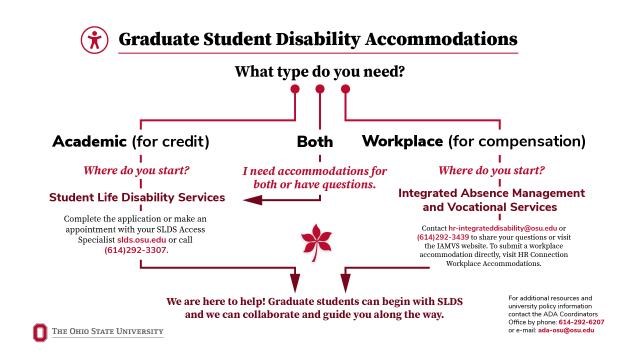
Graduate and professional students balance rigorous academic expectations, research, teaching, fieldwork, clinical training and, in many cases, paid university appointments. Students with disabilities may need support in one or more of these settings. At Ohio State, the process for accommodations depends on the context: academic accommodations are generally coordinated through Student Life Disability Services, while workplace accommodations for university employees, including some graduate associates, are coordinated through Human Resources Integrated Absence Management and Vocational Services. Students in instructional staff roles (e.g. Teaching Associates, Recitation Leader, Grader, etc.) also have access to the Michael V. Drake Institute for Teaching and Learning.
Where to start
Students who are unsure where to begin should identify the setting where the barrier is occurring. For barriers in courses, exams, clinical education or academic requirements, contact Student Life Disability Services. For barriers tied to paid work, lab employment, assistantship duties or workplace conditions, contact Human Resources. For teaching support, graduate students and postdocs can use Drake Institute programming to strengthen inclusive teaching practices. Asking early, keeping records and communicating with the appropriate office can help students receive support while continuing to make progress in their academic, professional and employment responsibilities.
How to request accommodations
Students seeking academic accommodations should begin by registering with Student Life Disability Services. The office works with graduate and professional students to review documentation, discuss disability-related barriers and determine reasonable accommodations for courses and other academic requirements. Students should start the process as early as possible, especially if they anticipate needing support for exams, clinical placements, field experiences, practicums, studio work, lab courses or reduced-distraction testing.
Registration typically includes applying, providing appropriate documentation and meeting with an access specialist. Documentation should help explain how a disability affects access to the academic environment. Students do not need to wait until a crisis point to ask questions. Early communication can help clarify what is possible, what information is needed and how accommodations are implemented across different learning environments.
What to do for accommodations as a student
After accommodations are approved, students are responsible for using the process outlined by Student Life Disability Services to share their course accessibility letter with instructors. Students are encouraged to communicate with instructors early in the semester, before barriers affect participation or deadlines. A short, direct message can help confirm how accommodations will work in a specific course, such as extended testing time, accessible course materials, note-taking support, flexibility related to disability-related absences or technology access.
Students do not need to disclose a diagnosis to an instructor. The course accessibility letter communicates the approved adjustments. If an accommodation does not appear to fit the course format, students should contact Student Life Disability Services as soon as possible. Graduate and professional courses may include seminars, labs, clinics, internships or performances, and implementation may require coordination among the student, instructor, program and access specialist.
What to do for lab, HR or graduate assistantship accommodations
Some graduate students also hold paid university roles, such as graduate teaching associate, graduate research associate or graduate administrative associate appointments. Others work in research labs, clinics, offices or field settings. When the need relates to job duties, work location, schedule, equipment or the employee side of a graduate appointment, students should use the workplace accommodation process through Ohio State Human Resources.
Workplace accommodations may involve an interactive process among the employee, Human Resources and the employment unit. Students may be asked to provide documentation that supports the request and explains functional limitations related to the workplace. Examples may include modified equipment, changes to work processes, schedule adjustments or other reasonable supports based on the role. Students should distinguish between academic needs and employment-related needs because approval in one setting does not automatically determine accommodations in another.
For graduate associates, communication is especially important because academic progress, funding and assigned duties can overlap. Students should review their program handbook, appointment letter and Graduate School guidance, and they may seek help from the graduate program chair, appointing unit, Graduate School staff or other campus resources if questions arise. When health-related circumstances affect time off or assigned duties, students should raise concerns promptly and document key communications.
Instructor best practices that support access
Faculty and instructors play a key role in making courses accessible and welcoming. Best practices include adding an accessibility statement to the syllabus, inviting students to discuss accommodations privately, responding promptly to course accessibility letter and treating disability information as confidential. Instructors should avoid asking for a diagnosis or questioning whether an approved accommodation is valid. Questions about implementation should be directed to Student Life Disability Services.
Accessible teaching also benefits students who may not have formal accommodations. Instructors can post materials in advance, use clear course organization, provide captions or transcripts for media, use accessible documents, explain expectations for participation and assessment, and offer multiple ways for students to engage when appropriate. Students assigned as Graduate Teaching Associates (GTAs) or other instructional team members also can build their skills through Drake Institute programs and services, including Graduate Teaching Orientation, GTA Teaching Toolkit, and individual consultations on any teaching topic.
If you need further support, let us support you!
Reach out to these offices:
- Office of Student Life - Disability Services
- For workplace accommodations: Office of Human Resources
- For instructional support: Drake Institute for Teaching and Learning
- General ADA and policy questions: ADA Coordinators Office
- For digital access support: Digital Accessibility Center (office) and Digital Accessibility Services (resource hub)
- General graduate education support: Graduate School