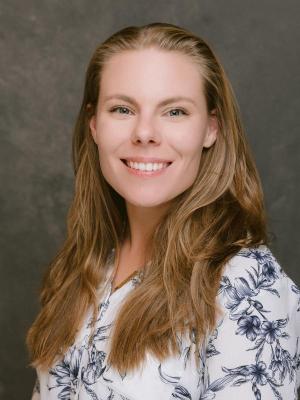
Calli Bellinger, a neuroscience doctoral candidate at The Ohio State University, is a recent recipient of a Presidential Fellowship, the Graduate School’s most prestigious honor for students completing the final phase of their dissertation research.
Bellinger conducts neuroimmunology research in the laboratory of Benjamin Segal within Ohio State’s Department of Neurology and Wexner Medical Center Neurological Institute. Her work focuses on how immune cell populations influence neuroinflammation and neural recovery, particularly in models of multiple sclerosis.
“My research focuses on understanding how different immune cell populations regulate inflammation in our mouse model of multiple sclerosis.,” Bellinger said. “Immune cells can both be beneficial and detrimental to our health. When they're left unchecked and are in areas that are very sensitive to environmental changes, immune cells can be quite detrimental. But on the other hand, they are very important. They're good at regulating inflammation, preventing foreign pathogens from causing even more damage, and even promoting repairs.”
Her research centers on microglia, immune cells that reside in the brain and spinal cord, and how they respond differently across regions of the nervous system. She hopes that by understanding how these cells balance inflammation in sensitive settings, treatments can be developed that are far reaching for conditions that impact the brain and spinal cord.
Beyond the laboratory, Bellinger has applied her scientific training in real-world situations. In 2023, she helped recognize and respond to a medical emergency when a fellow neuroscience graduate student experienced a stroke.
“…something was incredibly off because I know him really well and immediately something just clicked that maybe he's having a stroke or maybe he's having some type of medical emergency.” Bellinger said. “…thankfully we are on the floor with a lot of doctors and I know I'm not a medical doctor, but I knew exactly where to find one.”
She helped alert nearby physicians, contacted emergency services and assisted in getting her colleague to medical care quickly.
“It was really humbling though, and very terrifying because I knew how important and how dangerous the situation was.” she said. “It was amazing to see how someone could recover that quickly within a day, just because we responded so quickly.”
Both Bellinger and her colleague still work in the lab daily and this experience has provided a firsthand experience on how all the knowledge she has gained during her academic career can impact real people, sometimes someone sitting right down the hall from you.
Outside of the lab, Bellinger is also an active participant in Ohio State’s Life Sciences Interdisciplinary Graduate Programs and has presented her research at multiple annual Interdisciplinary Graduate Program symposia.
Concerning the impact of these symposia she said “It opens a lot of opportunity for collaboration” “Listening to how other people think about their own projects and being able to apply that to my own work has been very beneficial.”
The interdisciplinary format, she said, has helped her refine how she communicates her work and build a broader graduate community.
“I get to talk to faculty that are not familiar with my work or maybe not even close to familiar with my model, and I get the opportunity to explain it to them,” Bellinger said. “Being able to talk to other students and finding a community is very helpful”
The Presidential Fellowship places Bellinger among a select cohort of Ohio State graduate students recognized for excellence as they transition toward independent research careers. Receiving the fellowship marked a significant moment in Bellinger’s academic journey, particularly in a field where persistence through failure is essential.
“I've had to experience a lot of failure in my scientific career, and it can be quite difficult.” she said. “Getting the Presidential Fellowship was a great validation of, hey, even though you go through failure and you struggle, you are doing a good job. You are where you're supposed to be.”
The recognition, she said, reinforced her confidence and commitment to continuing her research. “It was a validation of all the hard work” Bellinger said.
Together, Bellinger’s research contributions, leadership in moments of crisis and engagement in interdisciplinary scholarship reflect the impact the Presidential Fellowship is designed to recognize and support.
As funding permits, each year, the Graduate School funds approximately 25-35 Presidential Fellowships in the annual competition. Presidential Fellowships provide financial support so the fellow may devote one year, 3 consecutive semesters, of full-time study to the completion of the dissertation or degree project and to graduate unimpeded by other duties. Calli is just one of these amazing students who will go on to impact the world using their graduate training and knowledge. Visit the Graduate School website to learn more about the Presidential Fellowship and previous awardees.